
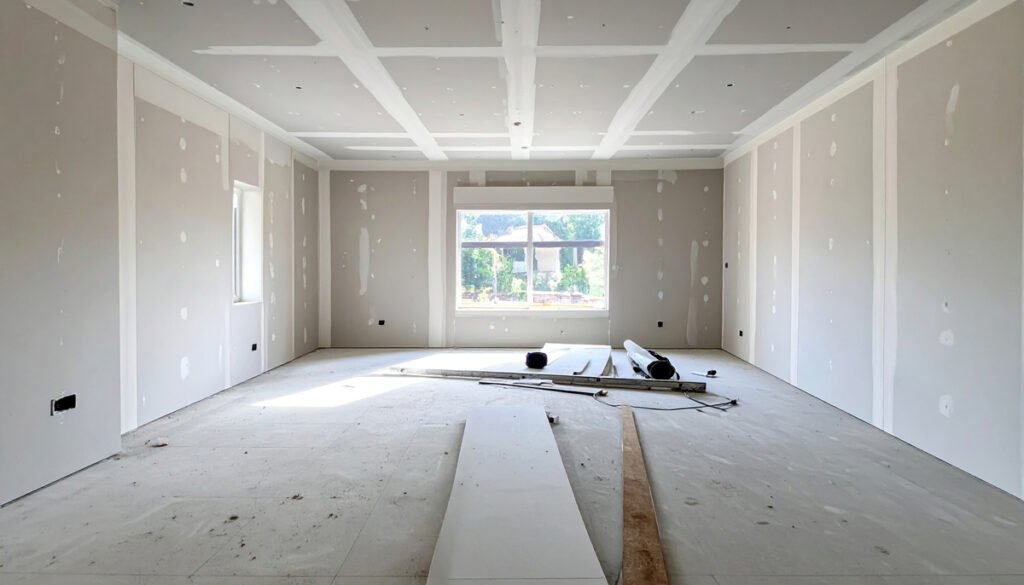
Why Professional Drywall Installation is the Foundation of Your Interior Space
Walk into any well-built office, retail space, or home, and you likely take the walls and ceilings for granted. They are smooth, uniform, and simply… there. This seeming simplicity is the hallmark of expert drywall installation and finishing—a trade where skill directly dictates quality. More than just hanging boards, it is the transformative process that turns a structural skeleton into defined, polished interiors.
For project managers overseeing a commercial build-out in San Antonio or homeowners embarking on a custom renovation, understanding this phase is crucial. Subpar drywall work leads to visible seams, cracks, poor acoustics, and an overall unprofessional finish that no coat of paint can hide. This guide delves into the precision world of drywall, explaining the critical steps, the differences between commercial and residential applications, and why partnering with a specialist like Minaya Construction ensures your Texas project’s interiors are as sound as its structure.
Commercial vs. Residential Drywall: Understanding the Key Differences
While the fundamental skills are similar, the specifications and goals for drywall can vary significantly between a corporate office and a private residence.
Commercial Drywall: Prioritizing Performance and Compliance
In commercial construction and tenant improvements, drywall is a engineered system designed to meet strict building codes.
- Fire-Rated Assemblies: Codes often mandate fire-resistant (Type X) drywall in corridors, stairwells, and between units. Proper installation of these multi-layer systems, including taped seams and specific fastening patterns, is legally required for occupant safety and insurance.
- Sound Control (STC Ratings): Offices, medical facilities, and multi-family housing require partitions that limit noise transfer. This involves specialized materials like sound-dampening drywall, resilient channels, and insulation to achieve mandated Sound Transmission Class (STC) ratings.
- Scale and Efficiency: Commercial projects involve large, repetitive areas. Efficiency is driven by detailed BIM coordination, prefabrication where possible, and crews specialized in fast, large-scale installation without compromising on the critical performance standards.
- Durability and Maintenance: High-traffic areas like schools, hospitals, and retail spaces require durable drywall that can withstand impact and allow for easy repair.
Residential Drywall: Focusing on Craftsmanship and Aesthetics
For custom home builds and residential renovations, the emphasis shifts toward flawless aesthetics and living comfort.
- The Pursuit of Perfection: In a home, lighting plays on walls from multiple angles. A Level 5 finish (a skim coat over the entire surface) is often standard to eliminate any hint of seams or imperfections under harsh natural or artificial light.
- Acoustic Comfort: While not always code-mandated, homeowners increasingly seek acoustic drywall or sound-insulating techniques for media rooms, home offices, and bedrooms to enhance privacy and comfort.
- Complex Details: Residential spaces often feature arches, curved walls, vaulted ceilings, and intricate soffits. These require skilled, hand-tailored work to execute cleanly.
- Minimizing Disruption: During renovations, a professional crew’s ability to contain dust, work efficiently, and manage debris is as important as the quality of the finish to a homeowner.
Our Integrated Expertise: At Minaya Construction, our experience across both sectors is a distinct advantage. We apply the rigorous standards of commercial drywall to ensure code compliance and durability in homes, while bringing the meticulous craftsmanship of residential finishing to the details of commercial spaces, elevating the overall quality.
The Step-by-Step Process to Flawless Drywall
Quality results come from a disciplined, multi-stage process. Rushing or skipping steps is where failures begin.
- Pre-Installation Inspection & Planning: Before the first sheet goes up, we inspect the framing for plumb, square, and proper fastener spacing. We plan the layout to minimize seams, avoid butting joints at door/window corners, and ensure sheets are staggered between rows for strength.
- Precision Hanging: Sheets are cut accurately for openings and fixtures. They are fastened securely to every stud or joist with the correct type and pattern of screws—driven just below the surface without breaking the paper face. Proper adhesive use can further strengthen the bond and reduce screw pops.
- Taping, Bedding, and Coating (The “Mudding”): This is the true art. Joint tape is embedded in a layer of joint compound (“mud”) over every seam, corner, and fastener. Two to three additional widening layers are applied, each feathered out further to create a seamless transition. Inside and outside corners are reinforced with metal or plastic bead.
- Sanding and Final Inspection: Once the compound is fully dry, the entire area is sanded smooth with a focus on eliminating ridges and tool marks. The final check is done with angled job-site lights that reveal any imperfections, which are then corrected. The wall must be uniform and ready for primer.
Common Drywall Failures and How Professional Installation Prevents Them
Understanding what goes wrong highlights why the process matters.
- Visible Seams (“Ghosting”): Caused by improper taping, insufficient layers of mud, or poor sanding. Our meticulous multi-coat process and final light inspection eliminate this.
- Screw/Nail “Pops”: Fasteners protrude due to wood framing shrinkage, improper driving, or framing movement. We use high-quality screws, drive them correctly, and often employ adhesive to lock the board in place, minimizing this risk.
- Corner Bead Cracks: Caused by impact or poor installation of the corner reinforcement. We secure bead properly and apply multiple layers of mud for a strong, flexible corner.
- Ceiling Sagging: Using standard 1/2″ drywall on ceilings with 24″ joist spacing, inadequate fastening, or moisture can cause sag. We select the right board thickness (often 5/8″) and follow strict fastening protocols for ceilings.
Investing in a Perfect Canvas
Drywall is the final structural layer and the primary canvas for every interior finish that follows. Choosing a contractor with the expertise to navigate its complexities—from fire codes in a San Antonio office building to the perfect smooth wall in a Hill Country home—protects your timeline, budget, and the long-term satisfaction with your space.
Does your current or upcoming project require interior walls that are built to last and finished to perfection? Contact Minaya Construction to discuss your drywall and finishing needs. Let us ensure your interiors have the flawless foundation they deserve.